Tuesday, November 24, 2009

Father and Son, Patriot and Loyalist

Critical Thoughts on Sheila L. Skemp's Benjamin and William Franklin

[Analytical Essay written for a college US History class]

Sheila L. Skemp’s Benjamin and William Franklin attempts to disprove the opinion that because Loyalists and Patriots had divergent political views they can simply be categorized into two parties: “good guys and bad guys.” Using the accounts of Benjamin Franklin (a Patriot) and William Franklin (a Loyalist), Skemp’s thesis demonstrates how both men wanted what was best for the colonies. It was their different perspectives of government, not their values, which collided.

The British government operated under a ‘checks and balances’ type system. Power was divided between the House of Commons, the House of Lords, and the Crown. If one of these sections of government attempted to encroach on another’s powers, colonists believed that either anarchy or tyranny would result. Thus, the Patriots saw parliament’s meddling in colonial affairs as tyrannous, but Loyalists saw the colonial assemblies’ desire for more authority as anarchical. Further, all colonists would have agreed that they possessed the rights of Englishmen. Yet, while Patriots would have argued that such rights could only be protected by rebelling against Britain, Loyalists stated that such rights would be threatened without a proper government to protect them.

Prior to the War, however, all colonists shared an integral belief – that they were Englishman. They were proud of their British heritage and of their King. Benjamin Franklin wrote, “Britain and her Colonies should be considered as one Whole, and not as different States with separate Interests.” (1) This was why Benjamin saw nothing wrong with and even helped his son to acquire the position of the Royal Governorship of New Jersey. The governor was appointed directly by the Crown (not elected by the colonial government). This meant that in order to keep his position, William would find himself having to consistently put the interests of the British government above that of the colonists. The Franklins, however, did not look upon these interests as conflicting. While both Britain and the colonies might have to make some compromises, the end result of their “close relationship” was “mutually beneficial” to both parties (2). As Benjamin and William began to follow very different political careers, however, this belief was continually tested. While his father eventually rejected it, William continued to cling to the traditional and long accepted view of the joint interest of England and its colonies.

Stationed in New Jersey, William’s experiences were shaped by direct involvement with colonial governments. At first, he had favorable opinions of the colonies. He grew angry over the “corrupt practices of England’s Board of Trade”, insisting that his “heart remained with the ‘Gentleman of America’” and decrying the British as having “little Knowledge of American affairs.” (3) However, while he found fault with the colonial proprietors, William still continued to cling to the belief that the colonies were dependent on the Crown. They could continue to exist in harmony by looking to the wellbeing of the empire as a whole. The wellbeing of the empire, however, was rooted in law and order. Even though William understood the colonial governments’ arguments against the various taxes that were being levied against them, he also believed that they were grasping for more power than was rightfully theirs. It was acceptable to criticize policy decisions, he argued, but the King and Parliament’s authority must still be respected. His experiences governing the colonies had shown him how “local jealousies” often undermined the public good. (4) Indeed, he and his father had already attempted once to unite the colonies with the Albany Plan of Union. The colonies had rejected it, however, fearing that it was a threat to their individual rights. This rejection, in William’s eyes, sacrificed their stability for idealist notions.

Essentially, William feared anarchy. As he observed the revolutionary activities, he wrote in a letter, “All legal Authority and Government seems to be drawing to an End here.” (5) William did not support the tyrannous acts of Parliament. Yet he also did not see them as a justification to completely dissolve colonial bonds with England. In his speech to the New Jersey Assembly on January 13, 1775, he warned against the convening of an illegal congress, stating that such an action would destroy “that Form of Government which it is your Duty by all lawful Means to preserve.” (6) Clearly, even though William did not share the sentiments of the Patriots, this does not mean that he was necessarily against their ideas of freedom, liberty, and self-government. In the same speech to the New Jersey Assembly, he agreed that the elected members of the assembly were “legal representatives” of the people of New Jersey and that they had been entrusted with “a peculiar Guardianship of their Rights and Privileges.” (7) He disagreed, however, that this self-government could be exercised without the oversight of a stronger and well-established British Empire. Independence from the Crown would result in political suicide and any “Rights and Privileges” previously enjoyed would be lost. (8) William (like so many Loyalists) did not know what the outcome of a Revolutionary War would be. He preferred to stand by a time tested system that offered stability over anarchy. The reasoning behind William’s stance proves that he was not an enemy to the colonies. Nor did he have to reject Biblical values in order to support his position. Indeed, William appears to have had a high respect for the Romans 13 command to respect the governing authorities.

Benjamin Franklin, on the other hand, as a representative of the colonies in England, came to understand firsthand the stubbornness and corruption of those in Parliament. Unlike William, he did not believe that independence would result in anarchy. Instead, he came to see the colonies as a rival power to that of England. He was cautious about revolution and at first advocated reform in the British government. Soon, however, he came to realize this was impossible. While his son urged the colonial assemblies to try to heal their rift with England peaceably, Benjamin Franklin understood how impractical this was. He saw that Britain refused to listen to the petition of the American colonies.

Neither William nor Benjamin made a decision overnight to join the Loyalist or Patriot camps. Rather, their beliefs developed as turbulent political events swirled around them. Ultimately, these decisions cannot be judged as necessarily morally right or wrong. William was just as much a patriot as his father. He loved the colonies and did not advocate a tyrannical government. Indeed, the ideas he clung to were ones previously shared by all colonists. Unfortunately, they had grown outdated and ultimately not viable. They could not survive the growing tensions between an Empire and her colonies.

Footnotes

1. Skemp, Sheila L. Benjamin and William Franklin. Bedford/St. Martin's, 1994. pg. 19
2. Ibid, 36
3. Ibid, 37
4. Ibid, 89
5. Ibid, 179
6. Ibid, 176
7. Ibid, 176
8. Ibid, 176

Labels: , ,

Posted by Nicole Bianchi at 3:26 PM |

Wednesday, January 28, 2009

Dusting Off the Cobwebs, Rearranging the Shelves

It's been little over a year since my last post on this blog. But that's no matter. I've decided to start writing here again. Mostly just because I miss it an awful lot. A blog is one of the few places where a writer truly feels at home on the internet.
HAD I the heavens’ embroidered cloths,
Enwrought with golden and silver light,
The blue and the dim and the dark cloths
Of night and light and the half light,
I would spread the cloths under your feet:
But I, being poor, have only my dreams;
I have spread my dreams under your feet;
Tread softly because you tread on my dreams.
- W. B. Yeats (1865–1939)

Posted by Nicole Bianchi at 12:47 AM |

Friday, December 07, 2007

Today in History - December 7th, 1941


Remembering Pearl Harbor

Labels:

Posted by Nicole Bianchi at 10:47 PM |

Friday, November 30, 2007

This Week in History : A Garden in Milan

[Meant to post this on the 28th, the anniversary of Augustine's death 1,577 years ago in 430. But since I haven't posted in so long, I suppose it'll be alright if I post it now instead.

I was browsing through old essays I had written for school and found this one I wrote several years back in the Schola Great Books II class. Wow, that seems like such a long time ago. =) It's a dramatization of Augustine's conversion.

If you haven't read any of Augustine's works, I highly recommend his Confessions. Augustine is one of the most important figures of the early Western Church and, while his theology wasn't always correct, his writing was extremely influential and helped strengthen the Christian church when the Roman Empire fell in 410.]

A Garden in Milan

I wished to speak to him, but I saw the tears rise to his eyes. He cast me a look full of sorrow and misery. The words I would have said choked in my throat.

Longing for solitude, he picked himself up and with trembling step, hurried off to a further corner of the garden.

I believe he thought I could not see him, but I could and I watched him intently. I knew what emotions racked his mind, for they racked mine as well, and I grew frightened for him.

He stumbled and threw himself down by a fig tree. The leaves danced fiercely in the harsh wind that had unexpectedly sprung up. He buried his face in his hands, weeping. I could see that from where I stood and I began to weep as well.

And then he spoke. At first, I could not catch the words, but as I listened closely, they became easier to understand. They pierced my heart and the tears fell more freely from my eyes.

“How long shall I go on saying ‘tomorrow, tomorrow’? Why not now? Why not make an end of my ugly sins at this moment?” he cried.

I had already seen the turmoil in my friend’s soul moments before. It was just after our guest, Ponticianus, had left. This man had noticed a book containing Paul’s epistles lying on our table. He immediately became overjoyed at our interest in the Scriptures and related to us a story about Antony, an Egyptian monk, who had given up everything he had to follow Christ. These things filled us with amazement at the greatness of such a sacrifice, but I noticed that they seemed to tear my friend apart inside.

When Ponticianus left, my friend addressed me in feverish tones. Although I do not recall the words he used, I knew by the strange high tone in his voice and the horrible expression in his face that he could not yet give up his sinful practices.

He ran out into the garden and I followed. In his agony, he tore at his hair and beat his forehead with his hands. And then he had run off to the fig tree and I thought it best to leave him alone.

I watched and I waited.

Then suddenly another voice fell upon my ears, light and sing-song, the voice of a child. Whether it the voice of a girl or a boy I could not tell, and at first, I was afraid it should disturb my friend, for he had looked up and inclined his head as if listening. I listened too.

“Take it and read,” it sang. “Take it and read.”

What did this mean? I had never heard a child sing these words before in any game.

My friend rose to his feet and quickly approached where I stood.

“Augustine,” I began to say, but he did not hear me. He picked up the book of Paul’s epistles he had cast aside when he left me, opened it, and read for several seconds. I watched him earnestly. And then I felt that wind that had sprung up, suddenly die down.

The voice of the child stopped singing.

My friend looked at me, his features quite calm, his face full of an emotion I had never noticed there before.

“Oh, Alypius,” he began. And then he told me everything. He told me of the emotions that had welled up within him. And he told me something that filled me with an inexpressible happiness.

For during this little episode in a garden in Milan, we had both passed from darkness to light, from wicked heathen practices to Christianity.

“What did you read?” I asked.

He showed me and I read it. And I found in those verses an admonishment that stirred my soul, but gave me great strength.

He gently put his hand upon my shoulder and said, “Alypius, we must go tell my mother. Her prayers have been answered.”

I nodded and as I looked into his face, a face devoid of all doubt and fear, I knew in my heart that this man Augustine was destined to do great things for God.

Labels: , ,

Posted by Nicole Bianchi at 12:03 AM |

Thursday, October 18, 2007

A Memory of Moments

UNIDENTIFIED GUEST. Ah, but we die to each other daily.
What we know of other people
Is only our memory of the moments
During which we knew them. And they have changed since
then.
To pretend that they and we are the same
Is a useful and covenient social convention
Which must sometimes be broken. We must also remember
That at every meeting we are meeting a stranger.

-T. S. Eliot, "The Cocktail Party"

Labels:

Posted by Nicole Bianchi at 12:10 PM |

Saturday, October 06, 2007

Poem in October by Dylan Thomas

[This is one of those poems that makes you catch your breath -- it's beautifully rich with imagery. I took the pictures last October at Rockefeller State Park here in New York. Enjoy!]


It was my thirtieth year to heaven
Woke to my hearing from harbour and neighbour wood
    And the mussel pooled and the heron
            Priested shore
        The morning beckon
With water praying and call of seagull and rook
And the knock of sailing boats on the net webbed wall
        Myself to set foot
            That second
In the still sleeping town and set forth.

    My birthday began with the water-
Birds and the birds of the winged trees flying my name
    Above the farms and the white horses
            And I rose
        In rainy autumn
And walked abroad in a shower of all my days.
High tide and the heron dived when I took the road
        Over the border
            And the gates
Of the town closed as the town awoke.

    A springful of larks in a rolling
Cloud and the roadside bushes brimming with whistling
    Blackbirds and the sun of October
            Summery
        On the hill's shoulder,
Here were fond climates and sweet singers suddenly
Come in the morning where I wandered and listened
        To the rain wringing
            Wind blow cold
In the wood faraway under me.

    Pale rain over the dwindling harbour
And over the sea wet church the size of a snail
    With its horns through mist and the castle
            Brown as owls
        But all the gardens
Of spring and summer were blooming in the tall tales
Beyond the border and under the lark full cloud.
        There could I marvel
            My birthday
Away but the weather turned around.

    It turned away from the blithe country
And down the other air and the blue altered sky
    Streamed again a wonder of summer
            With apples
        Pears and red currants
And I saw in the turning so clearly a child's
Forgotten mornings when he walked with his mother
        Through the parables
            Of sun light
And the legends of the green chapels

    And the twice told fields of infancy
That his tears burned my cheeks and his heart moved in mine.
    These were the woods the river and sea
            Where a boy
        In the listening
Summertime of the dead whispered the truth of his joy
To the trees and the stones and the fish in the tide.
        And the mystery
            Sang alive
Still in the water and singingbirds.

    And there could I marvel my birthday
Away but the weather turned around. And the true
    Joy of the long dead child sang burning
            In the sun.
        It was my thirtieth
Year to heaven stood there then in the summer noon
Though the town below lay leaved with October blood.
        O may my heart's truth
            Still be sung
On this high hill in a year's turning.


Labels:

Posted by Nicole Bianchi at 2:42 PM |

Friday, September 28, 2007

Today in History - 1066

I write these over on my xanga blog, but this one seemed particularly relevant to post over here.

Last year, my Brit Lit teacher informed my class that you can't possible love British Literature and not know what the 28th of September commemorates.


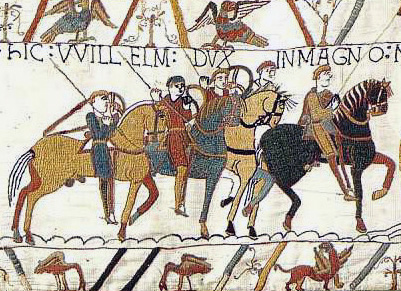
941 years ago today, in 1066, William the Conqueror invaded England, forever changing the English language and culture.

Here are several interesting links to learn more:

Wikipedia on the Norman Conquest

The Effect of the Norman Conquest on the English Language

And, of course, there is the Bayeaux tapestry! You can find several fascinating books on the tapestry, like Andrew Bridgeford's Hidden History in the Bayeux Tapestry. But there are also a huge amount of websites, like this one.

1066 was also the year of Halley's Comet and it made an appearance in the tapestry mentioned above:


The Latin words read "ISTI MIRANT STELLA."
That is, "These men wonder at the star."


It was seen as a good omen for William, but a bad omen for Harold II who died at the Battle of Hastings.

Labels:

Posted by Nicole Bianchi at 8:43 PM |

Sunday, September 23, 2007

dead languages

Very sorry for not posting for so long. I will try and write more often over the next several months.

Do you know today (the 23rd) is the very first day of Autumn!

Happy Fall! :)

And to make this post a wee bit interesting --

I read an article this past week about how nearly half of the languages spoken today are in danger of extinction. A language actually dies about every two weeks.

Being the foreign language fan that I am (I'm currently studying Italian), this made me rather sad. You can find more info at National Geographic here and here.

Although, who said dead languages aren't cool and shouldn't be learned even if they are 'dead'? Latin, anyone?

Labels:

Posted by Nicole Bianchi at 11:50 PM |

Friday, July 20, 2007

I'm back!

Whew, now I have about a month to actually enjoy my summer. Haha, yes, I'm joking -- I have been enjoying it very much. But now I'll actually have time to read.

I will have some more essays up here soon, but right now I have to post this poem. It's amazing. Enjoy!

Marginalia
By
Billy Collins

Sometimes the notes are ferocious,
skirmishes against the author
raging along the borders of every page
in tiny black script.
If I could just get my hands on you,
Kierkegaard, or Conor Cruise O'Brien,
they seem to say,
I would bolt the door and beat some logic into your head.

Other comments are more offhand, dismissive -
"Nonsense." "Please!" "HA!!" -
that kind of thing.
I remember once looking up from my reading,
my thumb as a bookmark,
trying to imagine what the person must look like
why wrote "Don't be a ninny"
alongside a paragraph in The Life of Emily Dickinson.

Students are more modest
needing to leave only their splayed footprints
along the shore of the page.
One scrawls "Metaphor" next to a stanza of Eliot's.
Another notes the presence of "Irony"
fifty times outside the paragraphs of A Modest Proposal.

Or they are fans who cheer from the empty bleachers,
Hands cupped around their mouths.
"Absolutely," they shout
to Duns Scotus and James Baldwin.
"Yes." "Bull's-eye." "My man!"
Check marks, asterisks, and exclamation points
rain down along the sidelines.

And if you have managed to graduate from college
without ever having written "Man vs. Nature"
in a margin, perhaps now
is the time to take one step forward.

We have all seized the white perimeter as our own
and reached for a pen if only to show
we did not just laze in an armchair turning pages;
we pressed a thought into the wayside,
planted an impression along the verge.

Even Irish monks in their cold scriptoria
jotted along the borders of the Gospels
brief asides about the pains of copying,
a bird signing near their window,
or the sunlight that illuminated their page-
anonymous men catching a ride into the future
on a vessel more lasting than themselves.

And you have not read Joshua Reynolds,
they say, until you have read him
enwreathed with Blake's furious scribbling.

Yet the one I think of most often,
the one that dangles from me like a locket,
was written in the copy of Catcher in the Rye
I borrowed from the local library
one slow, hot summer.
I was just beginning high school then,
reading books on a davenport in my parents' living room,
and I cannot tell you
how vastly my loneliness was deepened,
how poignant and amplified the world before me seemed,
when I found on one page

A few greasy looking smears
and next to them, written in soft pencil-
by a beautiful girl, I could tell,
whom I would never meet-
"Pardon the egg salad stains, but I'm in love."

Labels:

Posted by Nicole Bianchi at 3:16 PM |

Tuesday, July 10, 2007

Cry, the Beloved Country

Yes, I've been away -- traveling around the country (I went to Texas!) and studying at an economics seminar for a week. I'm off again this Thursday to Pennsylvania, but you can read all about that over here.

Now, for all my fellow literary-lovers that have been dying for a blog post while I've been away, here is an essay on a book that is an absolute must-read. Very highly recommended by me. Watch out though -- there are several spoilers. If you don't need to be convinced by my essay to read the book, then read the book first and then come back and read my essay. :)

A Light Will Dawn: Alan Paton's Cry, the Beloved Country

Cry, the beloved country, for the unborn child that is the inheritor of our fear. Let him not love the earth too deeply. Let him not laugh too gladly when the water runs through his fingers, nor stand too silent when the setting sun makes red the veld with fire. Let him not be too moved when the birds of his land are singing, nor give too much of his heart to a mountain or a valley. For fear will rob him of all if he gives too much.


Alan Paton’s Cry, the Beloved Country is just as passionate and socially relevant today as it was when first published in 1948. A Zulu pastor, Stephen Kumalo, searches for his lost son in a South Africa turbulently divided by racial injustice. Ultimately, the story portrays Kumalo’s spiritual journey from naiveté to a deeper understanding of his world, from confused anger to abiding peace, from a wavering faith to complete trust in the actions of God.

The opening pages are integral to the rest of the story as they describe the beauty of natural South Africa. With rich green hills and thick matted grass, it is almost a picture of Eden. Indeed, Paton writes, “Stand unshod upon it, for the ground is holy, being even as it came from the Creator” (33). Yet, the “hills break down…They fall to the valley below, and falling, change their nature. For they grow red and bare.” In relation to Kumalo, this latter description embodies his spiritual state at the beginning of the novel. His church is located in the desolate valley, not in the vast and wonderful hills. He enters the pages a broken and suffering old man. Though his character does change by the end of the book, it is not a radical transformation. In fact, he leaves the book, just as he entered, broken and suffering. Change does not happen overnight – it is a gradual process. It will take many years to renew the valley into the image of the glorious hills that surround it. It will also take Kumalo many years to change. Cry, the Beloved Country shows only the first small steps that he must take.

For a broken man, it is difficult to begin this journey. At the opening of the story, Kumalo receives a letter, urging him to come to the faraway city of Johannesburg. His sister, Gertrude, who had journeyed there once and never returned, has been found, but is very sick. Kumalo, however, is afraid to go to the city to bring her back. Absalom, his son, had traveled to the city to search for Gertrude and never returned. Saving uselessly the money that his son would have used to go to college, Kumalo has built up a wall of lies around himself, thinking they will ease his suffering. Futilely, he tries to convince himself that his son will return, though he knows in his heart he never will. This deception only breeds anger that finally spills out in this scene.

We had a son, he said harshly. Zulus have many children, but we had only one son. He went to Johannesburg, and as you said—when people go to Johannesburg, they do not come back….My own son, my own sister, my own brother. They go away and they do not write any more. Perhaps it does not seem to them that we suffer. Perhaps they do not care for it. (39)


Kumalo does finally decide to journey to Johannesburg and, eventually, he is reunited with his sister, brother, and only son. These meetings are far from happy, however. His sister has become a prostitute. His brother is a hardened man (he has lost all faith in Christ and is embittered against the white men, using his powerful voice to speak out against them at political rallies). And, most tragically of all, his son has killed a man and is doomed to die.

Yet, these individual trials form the foundation upon which Kumalo is able to grow spiritually. The man his son killed was Arthur Jarvis, a white man who fought for the rights of the black people in Africa. Living in his isolated valley, Kumalo had little contact with white men. In the city, however, he is able to witness more clearly the struggles between the two races. Through the murder, he is able to meet Jarvis’ father who lives in the green hills. Though the two lived in such close proximity to each other, they never met or talked to each other before. It is as though Kumalo’s sight had been myopic, able to see only his own desolate valley. Yet, it is from the white men that restoration will come to his valley and peace to his soul. At the beginning of the novel, his friend, Msimangu, had told him, “The white man has broken the tribe. And it is my belief—and again I ask your pardon—that it cannot be mended again (56).” Kumalo does not fully understand this statement until he witness for himself the hostility in the city and the resentment of his brother. Later on, Msimangu clarifies his statement with the words, “I see only one hope for our country, and that is when white men and black men….desiring only the good of their country, come together to work for it (71).”

Even though Absalom killed Jarvis’ son, the father reaches out (in the memory of Arthur who fought so hard for the rights of the black people) to help restore the valley. His grandson visits Kumalo and learns about the Africans’ plight. Jarvis then sends milk to the starving children and an agricultural demonstrator to teach the Africans how to farm. Slowly, Kumalo is able to see and understand Msimangu’s words as they become a reality. At first, Kumalo could not comprehend why he had to suffer so much. His heart was full of anger and hatred. If his son, however, had not killed Jarvis’ son, restoration would probably never have come to his valley. In the depths of his affliction, Kumalo had told Msimangu, “There is no prayer left in me. I am dumb here inside. I have no words at all” (105). At first, he could not see God’s perfect plan unfolding through these tragedies, but Msimangu encouraged him that “we are not forsaken” (123). As Kumalo looked around him, he suddenly realized that even in his suffering God was there. “Who gives, at this one hour, a friend to make darkness light before me?” he asked himself.

The novel ends with Kumalo waiting on a mountain on the day of his son’s execution. The anger that he felt over his suffering is gone. He now understands what it truly means in Romans 8:28, “And we know that God causes all things to work together for good to those who love God, to those who are called according to His purpose.” God used his trials to bring restoration to his valley and peace to his soul. As Kumalo watches the sun rise in the east, he begins to understand more deeply about God’s plans for his own country. Though now it seems that Africa is filled with darkness and hostility,

The light will come there. For it is the dawn that has come, as it has come for a thousand centuries, never failing. But when that dawn will come, of our emancipation, from the fear of bondage and the bondage of fear, why, that is a secret. (312)


Just as Kumalo could not see the ends of his suffering when he was in the midst of it, so he cannot yet see how Africa will come out of its darkness. Yet he knows that it must. For, as Msimangu had told him, God will never forsake them.

Works Cited

Paton, Alan. Cry, the Beloved Country. 1948. New York, NY. Scribner, 2003.

Labels: ,

Posted by Nicole Bianchi at 10:25 PM |

Related Posts with Thumbnails